Volume IV - Who Said Down Was Easy?
by Dan Rowley, Copyright (C)1998 Dan Rowley - all rights reserved
"It's all down hill from here-" it's a statement which clearly implies that the worst is behind you - all which lies ahead is easy, or is at least easier than what lay behind. There are countless endeavors for which I'm sure this particular aphorism is apropos, but hiking into a mile-deep hole in the ground isn't one of them. We may have believed when we began that we were in for an easy first-day's hike, but it wasn't long before any quaint notions we may have still harbored about downhill being easy were replaced by admittedly uncharitable thoughts about dead physicists. I mean, who does this Newton guy think he is, anyway, and if he thinks gravity is so cool he can damn well take this pack off my back and carry it to the bottom of the canyon himself. I suppose we should have seen it coming - after all, a mile is a pretty long way, and even though the South Kaibab trail meanders across some 10 miles on it's way to the bottom, that's still a drop of a foot for every ten feet walked. If that doesn't sound like a lot, multiply it by 52,000 feet travelled and try again. See? I knew you'd come around to seeing it my way.
So, here we were - an intrepid band of urban adventurers taking our first steps into this stunning example of "geology in action." (If you think it's a trifle incongruous to use "geology" and "action" in the same sentence, just talk to a geologist for awhile - they think in such immense time scales that one imagines that it must be difficult for them to even notice mere days passing). We weren't fifty feet into the trail before we met the first of what was to be our constant companion for the duration of the trip - a switchback. Switchbacks are like dirty diapers - when new parents see and change the first few, it's almost cute ("oh look! Junior made a little stinky!"). The novelty soon wears off, though, and gives way to mild annoyance. The annoyance transmutes into a sort of tired resignation, and lingers there for some time, but is eventually overtaken first by bitterness and then extreme rancor. You all pretend it's a joke, but you begin to wonder if a cork wouldn't be a bad idea after all. So it was with our switchbacks. It's hard to get a feel for the altitude you are about to cover as you look down at the maze of switchbacks ahead of you, but it only takes one look back to put it all in perspective. Don't get me wrong - getting down would be virtually impossible without the switchbacks, and they had the added benefit that they virtually guaranteed repeated opportunities to photograph stunning vistas - If you missed something the first time by, you could always catch it the next time, or the next time, or...well, you get the point. Another advantage is that since you're constantly facing different directions, the sun can more uniformly cook you - it's like nature's own rotisserie. So, like any well-prepared hikers, we came armed with high-numbered suntan lotion and wide-brimmed hats.
For the serious hiker, a hat is more than a fashion accessory. Sure, the right hat is essential to striking the "casual wanderer" pose (If you can pull it off, a floppy Indiana Jones-style fedora is a particularly nice touch), but for those of us with fair skin (and those with hair in various stages of retreat), it's vital. Since my genes consign me to belong to both of these categories, I chose this trip to inaugurate a new hat. I've always been jealous of Byron's hat. It's a well-worn floppy leather fedora that is the picture of experience - the sort of hat you could hang on a wall and use like a coffee table book to spark interesting conversation and trigger fond reminiscences. Of course, such a hat only works if it "fits" the one who wears it - not "fit" in that it's the right size, but that it looks at home on the head of the wearer. Put simply, Byron looks like he was born with this hat on. So, when we stopped in Flagstaff for the night before the trip we made a pit stop at the local Popular - I for my hat, and others for the laundry list of "little things" that we'd forgotten to pack, or more likely, didn't know we needed until we saw them on the endcap at the store. After much vacillating, I adopted a friendly-looking brimmed hat - complete with leather string - and promised myself I'd show it some adventure, and give it a good home.
It wasn't long before I was very glad I had made that purchase. Unlike the Bright Angel Trail, there is very little shade on the way down the South Kaibab Trail. Our trusty trail guide also informed us, correctly, that there was also no water anywhere on the trail. This was a welcome change of pace, considering our previous experience with trail guides and dire predicions of no water (see "On Bears, Knots, and the Wetness of Water" for more on this subject).
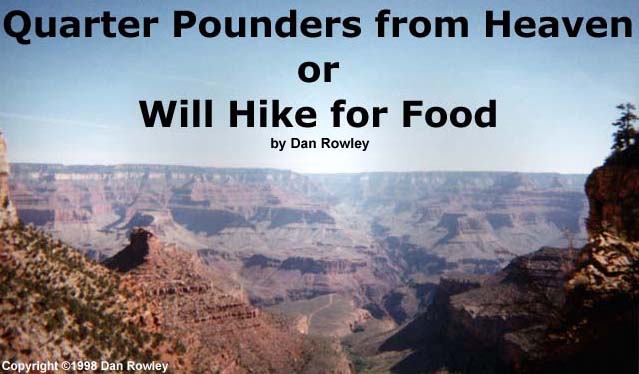
We came to the canyon expecting a spectacle of epic proportions, and we were not disappointed. Pictures and words can scarcely do justice to the sweeping vistas which met us at virtually every turn. You could actually see the color of the ground changing below your feet, as you descended through the various strata that make the canyon walls so picturesque. As you descend, you're literally walking backwards in time, treading on long-buried rock from the past which was only recently (in geologic terms) uncovered by the relentless scouring of the river. I read someplace that the rock exposed at the bottom of the canyon is the oldest exposed rock in the world.
Pedestrian traffic was actually quite heavy near the top, but thinned considerably as we moved outside of the "day hiker zone." After a few miles, most day hikers had heeded the prominent signs warning of possible, even probable, danger and/or death if you tried to hike all the way to the bottom and back in one day - especially without lots of water. Once we were finally alone on the trail, it was easy to believe, standing on a rocky promontory overlooking sheer rock cliffs and deep canyon rifts, that you were utterly alone with nature - at least until somebody farted. Okay, so discussing intestinal gas in the midst of a treatise about the grandeur of nature is probably in bad taste, but it's worth noting that physical exertion and a high energy diet are not without their by-products. Thankfully, though, fresh air is in good supply at the Grand Canyon, so long as you aren't following a mule train, or stepping over the evidence of the recent passage of the same.
It was about five or six miles in when we started to become acutely aware of our legs and feet. This isn't to say that none of us had noticed that we had feet up until now, but that our trusty appendages seemed to be quite happy living out an anonymous existence at our extremities. Like small children clamoring for the attention of their parents, though, our feet began to report that all was not well, and would we please see what we could do about it before they had to seriously make a scene. It turns out that repeatedly bashing your toes into the front of reinforced hiking boots *hurts*, and all that silly talk on shoe commercials isn't all that silly after all. We can all talk about having proper support as we toodle from store to store at the mall, but it rapidly became clear to us that footwear was a serious issue. We took a short break to examine our battered feet, which was probably a mistake, since *seeing* the skin you've left on the inside of your sock makes it considerably easier to *feel* it. We still had about halfway to go, though, so we covered our feet in moleskin and tied our boots so tight it's a wonder our feet didn't fall off for lack of circulation. No hiking trip would be complete without a few blisters, though, and as long as our minds (and eyes) were otherwise occupied, it wasn't too hard to forget, at least temporarily, about our growing discomfort.
It wasn't long before we hit our first serious milestone - the first view of the Colorado River. It was pathetically small, but the mere sight of our goal was electrifying. It's one thing to know, intellectually, that your goal is down there "somewhere," but it's easier to summon the energy to fight an enemy you can see, than to battle against the unseen. The river soon passed from our sight, but the brief glimpse of our goal was enough for us to paint a mental "you are here" on our internal battle map, and to galvanize us for the last stretch of the hike down.
This last stretch, it would turn out, would be hot, steep, and utterly exhausting. By now we were all starting to walk funny - favoring one side of the foot or the other, trying to keep our toes from being jammed into oblivion in the front of our boots, and wondering whether our blisters had blisters of their own, or indeed if our feet were just giant blisters themselves. We made measurable progress, though - each time we saw the river it was noticeably closer, and we could now pick out details of the two foot bridges and structures on the shore of the Colorado. We didn't know it at the time, but we also had a great view of what would turn out to be our accomodations for the night - Bright Angel Campground on the shores of Bright Angel Creek. It wasn't until we got the pictures back later that we knew we had seen our campground from above. As we neared the bottom, the progress was palpable, and we started to get our second wind, so we picked up the pace a bit and bent to the task of reaching our now-visible goal. It wouldn't be long before we could shuck our bags and commence with some serious relaxing.
stay tuned for part V - Arrival
Comments? email me!